Monday, April 23, 2007


Sunday, April 22, 2007
Review: The Villain, by Jim Perrin
 "You do know that he was an absolute bastard, don't you?"
The words of Very Famous British Climber, Joe Brown, referring to another of the same ilk, Don Whillans. These two names, forever linked, are two of the very few that the general-non-mountaineering populace of Britain have ever heard of. Along with Hilary, Bonington and only a few others, the names of Whillans and Brown cast a very long shadow over British mountaineering. In The Villain, Jim Perrin takes it upon himself to separate myth from fact and produce the definitive biography to one of climbing's greatest characters; Don Whillans.
I've never really been a fan of Jim Perrin's monthly columns in various climbing magazines. Yes, the guy has a way with words, yes he is a bit of a legend in British (and especially Welsh) climbing, but a lot of his writing is rather overly prosaic for my tastes. Over at UKC, tobyfk wittily commented recently that he had come up with a random Perrin article generator, sample output:
Large sensual hands lorem ipsum dolor sit amet, onto the ridge of Moel Llyfnant, consectetuer adipiscing elit. Sed quam tortor, resonates with ancient dignissim sagittis descending from Esgeiriau Gwynion vestibulum vitae magical landscape. Looking across to Foel Hafod Fynydd suspendisse sit amet extraordinary richness of textures .....
which is about right. I mean, the last piece I read of his was in the Guardian, where he'd written a small column about going out at night to watch badgers shagging. Each to their own, I suppose.
The point of all this is that it left me a little bit worried when I got my hands on The Villain. Wouldn't Perrin's propensity to eulogise over-dramatise such an important story? Given the reputation of the subject, this is a book that really has to be done right, if at all. Yet on the flip-side, who else is better qualified to undertake such a burden, given that there are few other people who can a) say that they are/were on first name terms with most if not all the characters in the book, and b) have several years of professional writing experience (no matter how prosaic it tends to be)?
That Don Whillans was one of Britain's greatest rock-climbers and mountaineers is beyond doubt. He blazed a trail of new routes over the entire country that are almost unanimously direct, inspiring, brutal, and hard. After several failed expeditions he finally bagged a major first ascent in the greater ranges, after he and Haston summited Annapurna via its south face, an achievement that ushered in a new era of Himalayan climbing, both capping Whillans' career and simultaneously sowing the seeds for its demise. For unfortunately Whillans was known as much for his brash persona, arrogance, fighting, drinking and womanising as he was for his climbing; traits that were increasingly difficult for his peers to gloss over as the years went by.
Fortunately, Perrin seems to be aware that this book is not the place to waffle on about badgers and the beauty of Welsh hills. He keeps his most prosaic style firmly locked up, at least until the final chapter, by which time we are happy to forgive a short burst of it. His chronological account of Whillans' life sticks to the facts, allowing the stories generated by Don and his peers to maintain the reader's interest. I was interested, and rather pleased to see that Perrin avoids painting too bad a picture of Whillans. Fundamentally, he seems to be saying, Don wasn't the monster that myth and legend would have him to be, and several passages of the book pay tribute to more positive aspects of his character. However, he never gets too carried away with the notion; every now and again a brief anecdote (usually revolving around drinking, fighting, womanising, or all three) reminds us of how unpleasant a character he could be.
The one passage that entertained me the most was the story of Whillans and Haston (again) this time within a couple of hundred feet of summiting Everest, by a new route direct up the south west face. They had managed it 9/10ths of the way up, and saw an obvious traverse line out to the (much easier) south east ridge (and thus the summit). To take this traverse would have been understandable, but a bit of a cop-out - the main challenge was to make an entirely new route, independent of others, and to take the traverse would have diluted the purity of the climb. To a mountaineer like Don, this was not good enough; the lure of summiting Everest without taking the new, independent line was just not present, so they carried on up their independent line. Too late they realised that it was much harder than they anticipated, and with worsening weather they decided to retreat, having neither succeeding to climb the entire new line, nor even reach the summit via the easier route. Their eventual return down to a lower camp, after 21 days at high altitude that ended in failure, was described by another climber, John Clears, and is quoted in the book:
"I watched Dougal [Haston] come down the fixed ropes and stagger towards us down the Cwm. He was zonked. He looked like a Belsen victim and dragged his feet through the snow. Pemba rushed out to meet him with a big kettle of hot fruit juice. Dougal flopped in the snow to drink it, and then, supported on Pemba's shoulder, he staggered into camp - shot.I thoroughly recommend reading the book.
Ten minutes later Don swung off the bottom of the ropes. He strode down the path towards the camp humming a tune and dribbling a snowball at his feet. Pemba ran out with the kettle and Don dismissed the friendly little sherpa with a friendly slap on his shoulder: 'Thanks, Pemba, but I'll have what's left of the real stuff'. He reached inside his down suit, pulled out what was left of a half-bottle of Glenfiddich, and knocked it back in one gulp. Then he chucked the bottle over his shoulder and strode on down to the accompaniment of a loud belch"
Tuesday, April 17, 2007
Flat hunting in Barca
 I'm so chuffed that the Med has decent waves, that I'm going to show you another picture from www.funkysurfing.com, this one taken four days ago. 3-4 feet of solid swell, and pretty clean to boot. Sigh...
The good news is that I confirm that the pic above, and all the rest on that sight, aren't fakes - this Saturday Djanira and I strolled down to Barceloneta and there it was, a solid 3-foot swell (unfortunately messed up by a strong cross-off breeze), and about 50 surfers enjoying it. Further up the coast at Vila Olimpica a fatter wave had about 30 longboarders on it, which tbh looked like it would work better on a westerly swell instead of the southerly that was present, but showed promise nonetheless. The swell dropped a little on Sunday but was still rideable, and by Monday it had gone.
So, wave-hunt successful, we returned to the lesser-important of our two goals for the weekend, finding somewhere to live*. Barcelona is quite a compact city, squeezed in between the mountains and the sea, and it would appear that all city architects had this on their mind while designing the apartment blocks - why have one large bedroom when you could have three tiny ones, right?!
Our number one criteria for a flat is that it has to be near the sea. After years of neglect, Barcelona has spruced up its beaches and they are really brilliant now; clean, safe, pretty, modern and easy to access. We saw a couple of flats downtown but they weren't right - they just made us realise how important being near the sea is to us. The barrio of Barceloneta appears perfect on paper (yes, that's the main surfing beach!) but unfortunately the flats there are almost exclusively only 35m2. Which, frankly, is too small. So we're looking further up the coast, specifically at Poble Nou. It's a suburb, but quite a nice one, and it should be possible to get a bigger place there. Vila Olimpica, in between the two places, has some big flats too but frankly the place is soul-less. It was build for the Olympic games as housing for the athletes, and while it's pretty enough it has all the character you might expect from an area that was effectively razed to the ground and re-built within a few months.
We didn't find anywhere ideal this weekend but we learned a lot. We plan to arrive there mid-May, and so our likely course now is to live in short-term accommodation for the first fortnight while we find the right place.
* this is a joke, Mum. Aha.
Tuesday, April 10, 2007
Pembrokeshire climbing
 Since the late 70s, the Easter bank holiday weekend has seen vast quantities of climbers descend on the small village of Bosherston to climb on the cliffs of the Pembrokeshire coast. 'Big deal', you may say, the same happens at any number of crags all over Britain. The difference is that the Easter 'meet' at Pembroke has a bit more tradition about it - in the late 70s/early 80s, the campsite at Bosherston would swell with some of the leading climbers of the day who would all head off out to force new routes and generally explore the coastline. In those years the brilliance and sheer volume of rock climbing in Pembrokeshire was rapidly unearthed, and the Easter weekend was the unofficial 'opening weekend' of the season. These days the supply of new routes has all but dried up, with only the most difficult challenges remaining unclimbed, but Easter time at Pembroke has still retained that special vibe, where pasty climbers emerge from their indoor walls and leave their freezing gritstone problems, and enjoy a long weekend ticking a seemingly endless stream of quality rock-climbs, probably getting a healthy tan along the way. This Easter was no different.
A few months ago I started making noises to see who'd be interested in Pembroke at Easter, and thanks the efforts of Ian Lau the numbers swelled until there was a good 15-20 of us who knew each other, joining the couple of hundred climbers camping in the various fields that are opened up by the Bosherston residents. The atmosphere in the village was great as usual, loads going on, lots of smiling faces and a great buzz around the pub in the evening - which, incidently, probably took around £20K over the course of the weekend. The weather was perfect, sunny and warm but with a crisp air temperature that ensured climbing conditions never got too greasy. I climbed on alternate days with Djanira and Jo Bertalot, and managed to tick off several classics that I have had my eyes on for a while, from the uber classic Hard-Severe Bow-Shaped Slab at Flimston Bay, to seconding Jo up a the 3* E4 Body Language at St Govan's East. I led a couple of E3s, the best of which was probably Forbidden Fruits, a pumpy face-climb also at St Govan's East. My fitness is good but I still have plenty to learn - I didn't fall but spent ages faffing around with gear during the crux sequence, so making the final moves harder than they should have been. Still it was my first trad weekend since a visit to the Wye Valley last September, so I'm pretty pleased. I was also quite happy to speak as much Welsh as English this weekend - the Bertalot brothers grew up in Pwllheli, and all my climbing with Jo was done through the medium of Welsh - a first for me and very nice too.
I was particularly pleased that Djanira really enjoyed the weekend too and has refound her climbing 'mojo'. We had quite an adventure on the classic VS Blue Sky at Saddle Head, which involved a free-hanging abseil and getting drenched by a big wave on the belay ledge at the bottom. Good job it was hot and sunny, and that the climbing was so good! DJ also seconded Cathy up an E1 at St Govan's East, Calisto, so well done to both of them.
Climbing wise I have one more weekend's trad in a fortnight before it's off to Spain and the world of bolts. I have no doubt though that I'll be back in Pembroke next Easter!
Tuesday, March 27, 2007
Barcelona waves
 So the move to Catalunya comes ever closer (beginning of May now) and we are just starting to get plans in order. There is a lot to do and think about - how do we get out there (fly/drive/ferry), how much/what stuff to take, bank accounts, accomodation etc.
The only one thing that has been worrying me about Barca is that, for all the amazing climbing nearby, the quality mountain biking just outside the city, and the fact that the ski-lifts of the Pyrrannees are only a 3 hour drive away, the fact is that the Med is not exactly famous for it's waves. In fact, for 8 months of the year it is pretty much as flat as a mill-pond. I had heard rumours that the winter months bring some small swell every now and again, but months of web-searching only found a couple of low-res pics, and a lot of hearsay.
Yesterday though, while searching for an example to show Mr Rhys, I happened to stumble upon www.funkysurfing.com, a photo-diary dedicated to "the waves of Barcelona and Tarrogona". Check the waves of two weeks ago, at Barceloneta (the city's main beach). Needless to say, my mouth hit the floor, and perusal of the rest of the season's waves revealed at least some sort of consistency. From the pics I'm guessing that the winter waves of the Med are about the same size and consistency as summer waves in Wales (i.e. usually a foot or two of wind-chop, with the occasional bigger and/or cleaner day). I guess I'll only be able to see how consistent it really is when I live out there, but one thing's for sure - if waves like the one below come along even once every couple of months, I'll definitely need my board!

Monday, March 26, 2007
7a+
 Two weeks ago I was sport climbing down at Portland with Macca and Hugh Merrick and, bearing in mind the difference between trad and sport, worked the moves on a 7a+ called Victims of Fashion. 7a+ is a bit of a funny grade for me, technically I've onsighted at this level in the past, but that was in Spain and everybody knows that Spanish grades are soft(!); the highest I've managed over in the UK is a redpoint of a 7a at Blacknor (also in Portland - Medusa Falls for those that know it). So anyway I worked Victims of Fashion two weeks ago and got completely knackered, I couldn't even link it on a top-rope let alone think about trying to redpoint it, so I put it in the bag for another day. That day arrived on Sunday, and I was pretty keen. I'd been doing a bit of finger strength work in the last fortnight and I was hoping that it would make the difference.
The key in this sort of situation is to remember that you're trying to redpoint a sport route. So after warming up on a couple of other routes (including an onsight of Out of Reach, Out of Mind) I didn't jump on my project and try and climb it one push straight away, I spent half an hour hanging around on it (thanks Al!), resting at each bolt, not using too much energy, working the moves over and over until I was satisfied. Then I came and rested for 20 minutes, went through the entire sequence of the route in my head, and set off for the lead. The result: 7a+ ticked on first redpoint, and a big smile on Alun's face.
In fact, I had so much energy left in the bank that I redpointed a 7a (Trance Dance) an hour later! Chuffed!
Wednesday, March 21, 2007
Trad vs Sport
One of the threads on UKC has raised a very important point with regards to the difference between 'traditional' and 'sport' climbing (non-climbers: see note*). As sport climbing is so rare in Britain, many climbers here don't understand its attraction, as it is simply not as adventurous (no real risk, relying less on your own initiative, usually not even reaching the top of a given crag).
But of course they are different games, something that was summed up nicely by UKC poster abarro81:
* 'trad' climbing is when you ascend the rock placing your own equipment in natural features and fissures to save you in the event of a fall, which is removed with little damage to the rock by the person following you; whereas 'sport' climbing sees you relying for safety on bolts and hangers that have been drilled into the rock. Trad is more adventurous than sport, but the relative safety of sport climbing makes it easier to climb at a higher standard, as the only thing you risk hurting when you fall is your ego).
But of course they are different games, something that was summed up nicely by UKC poster abarro81:
I think a lot of people in the uk, particularly those who dont enjoy pushing themselves technically so much, just arent used to climbing sport so they do it in the same way they go trad climbing.Which mirror my thoughts exactly. There's no doubt that the rush you get of getting to the top of a brilliantly exposed trad route is amazing - but succesfully reaching the lower-off chains on a really hard sport route, which you have been practicing and trying for days, is also a brilliant feeling. As Lito Tejada-Flores wrote years ago, there are lots of different games in climbing, and being able to appreciate the draws of the different games makes climbing the satisfactory and fulfilling hobby that it is.
They'll go out and do a bunch of stuff below their limit and maybe top rope something their mate lead which is a bit harder. I can see how they find this lame - I find easy sport climbing boring tbh. i think those who like sport climbing generally like that you can onsight at your absolute limit and work stuff that at first seems absurdly hard.
A lot of people i know who dont like sport so much have just gone trad climbing with bolts rather than sport climbing in the above way. i think it takes a different approach than trad.
* 'trad' climbing is when you ascend the rock placing your own equipment in natural features and fissures to save you in the event of a fall, which is removed with little damage to the rock by the person following you; whereas 'sport' climbing sees you relying for safety on bolts and hangers that have been drilled into the rock. Trad is more adventurous than sport, but the relative safety of sport climbing makes it easier to climb at a higher standard, as the only thing you risk hurting when you fall is your ego).
Monday, March 19, 2007
Finally
 Well, we managed to get a victory at last. And let's face it, if you'd come up to me, or any other Welshman, before the tournament saying "you can only beat one team this year, which do you choose" then it's a bit of no-brainer.
But let's face it - England just did not show up on Saturday, and Wales didn't really play any different to the how they played in the rest of the tournament. This isn't actually such a damaging statement - we should have won against Ireland (people forgot that pretty quickly), drew against Italy, and while the Scottish game is one to forget, we didn't embarrass ourselves in Paris. Yet the reality is that we're still not clinical enough. On Saturday was that the our pack got the upper hand and turned the screw on the English from an early stage in the game, which meant quick ball and consistent movement over the gain line. That, coupled with Hook's excellent kicking game, meant that 75% of the game was played in England's half and to lose a game with that amount of territory is a almost impossible - but the scoreline didn't reflect the Welsh dominance. Let's be blunt about this, Wales should have been 30 points up at half-time, and should have won by 40, and only a lucky bounce, a moment of magic from Ellis and several moments of selfishness from Shane Williams prevented that. There is still a lot of work to do before the world cup.
As for England... only more questions, no answers...
Saturday, March 10, 2007
News flash: time warp discovered in Stadio Flamino, Rome!
Science boffs worldwide are in shock this afternoon, after a freak time-warp incident occurred at a popular sporting event.
Awarded a penalty in the dying seconds, and with the choice to draw the match by kicking for goal, or go for the win by going for a lineout in the corner, the Welsh rugby team were clearly told by the match official that there were 10 (ten) seconds remaining on the clock. The Welsh decided to go for the win, and so drilled the ball into the corner for the lineout.
Yet, amazingly, the mid-flight ball must have entered what scientists are terming a 'local anomaly in the space-time continuum', because despite leaving James Hook's boot at high velocity, the time it took to travel the 30 yards to the touchline must have been greater than 10 seconds, because the ref blew for full time immediately afterwards.
Controversially, some Welsh supporters have suggested that the referee made a mistake, thus robbing Wales of at least a draw, and maybe a win. However their calls were jeered by the mass of physicists all excitedly discussing the new era in physics
Awarded a penalty in the dying seconds, and with the choice to draw the match by kicking for goal, or go for the win by going for a lineout in the corner, the Welsh rugby team were clearly told by the match official that there were 10 (ten) seconds remaining on the clock. The Welsh decided to go for the win, and so drilled the ball into the corner for the lineout.
Yet, amazingly, the mid-flight ball must have entered what scientists are terming a 'local anomaly in the space-time continuum', because despite leaving James Hook's boot at high velocity, the time it took to travel the 30 yards to the touchline must have been greater than 10 seconds, because the ref blew for full time immediately afterwards.
Controversially, some Welsh supporters have suggested that the referee made a mistake, thus robbing Wales of at least a draw, and maybe a win. However their calls were jeered by the mass of physicists all excitedly discussing the new era in physics
Thursday, March 01, 2007
Gower Bouldering Wiki

Over the spring of 2006 I was writing up my PhD, and during my better efforts to avoid it I went off bouldering around Gower. Finally, my labours have now come to fruit (it was a hard job etc. etc.) with the Gower bouldering wiki:
http://gowerbouldering.wetpaint.com/
check it out...
Wednesday, February 21, 2007
Another training article
Dave MacLeod has written a short article for UKC. The most interesting bit of it for me was this:
...[improvement] isn’t possible without showing a bit of backbone. Everyone makes excuses, you can hear them all the time if you listen. Keep one ear on the ones coming out of your own mouth and every so often you have a ‘wake up call’ moment. Right there is the scaffold of your motivation to make a break to the next level.I like this attitude; it emphasises a can-do approach to becoming better at whatever you're doing. Training to improve at anything is all about identifying your weak-points and working to improve them - and the first step to doing that is to admit what your weak-points are.
Thursday, January 11, 2007
No more Capoeira
After a few days of jet-lag, I'm just about getting back up to speed with the world here back in London, a feat that's been double hard thanks to the fact that there is just so much ar y gweill at the moment. Work is busy, PhD viva soon, and I am preparding for the move to Spain, both professionally and logistically. The upshot of it is that play time is in short supply at the moment yet, as I have said before, all work and no play makes Alun a dull boy.
Recently, play-time has been split between climbing and capoeira, but I'll be honest the situation hasn't been ideal. I have reached the 'first peak' in capoeira - I can confidently step into the roda and play a simple game, and enjoy and appreciate and enjoy a good game when played by others. Yet rather than being happy about this, it's actually a little daunting: I've scaled the first peak, only to see the huge mountain range ahead, and realised just how much hard training is required to scale those mountains.
The mountaineering allegory is a good one, because it leads back to climbing. I realised last night, when riding home from the wall (or rather, the pub next to the wall), that climbing is still my number one. It is what inspires me and motivates me, drives me and pleases me. Because of capoeira, my climbing has suffered over the last few months, and I'm not happy about it. I have realised that I have to dedicate to one or the the other - trying to do both means that I will never improve at either, and risk getting bored with both.
If this reads a bit like a confessional, then it's probably because it feels like it is. I love capoeira, I think it's brilliant, and strangely I feel guilty for stopping. But stop I must. You know you've made a correct decision becuase once you've made it, you feel this massive weight lift off your shoulders. That's how a felt last night.
Bouldering in the Peak District on Sunday. Alright!
Recently, play-time has been split between climbing and capoeira, but I'll be honest the situation hasn't been ideal. I have reached the 'first peak' in capoeira - I can confidently step into the roda and play a simple game, and enjoy and appreciate and enjoy a good game when played by others. Yet rather than being happy about this, it's actually a little daunting: I've scaled the first peak, only to see the huge mountain range ahead, and realised just how much hard training is required to scale those mountains.
The mountaineering allegory is a good one, because it leads back to climbing. I realised last night, when riding home from the wall (or rather, the pub next to the wall), that climbing is still my number one. It is what inspires me and motivates me, drives me and pleases me. Because of capoeira, my climbing has suffered over the last few months, and I'm not happy about it. I have realised that I have to dedicate to one or the the other - trying to do both means that I will never improve at either, and risk getting bored with both.
If this reads a bit like a confessional, then it's probably because it feels like it is. I love capoeira, I think it's brilliant, and strangely I feel guilty for stopping. But stop I must. You know you've made a correct decision becuase once you've made it, you feel this massive weight lift off your shoulders. That's how a felt last night.
Bouldering in the Peak District on Sunday. Alright!
Wednesday, January 10, 2007
USA Trip: Final Photos
 Well we're back safe and sound, and recovering from the jet-lag, which has been awful for the last few days.
Of the 350 (!) photos we took there's a more manageable 60 now uploaded here. Let me tell ya somethin'...
Friday, January 05, 2007
USA Trip: Back to Vegas
There's a classic Monty Python sketch in which Death (that's with a capital 'D', i.e. the Grim Reaper) loses patience with a Yank who's trying to butt in all the time. Death, who is frightfully English, of course, snaps:
"You always talk you Americans; you talk and you...talk, and you say things like, 'let me tell ya somethin', and, 'I just wanna say this!'. Well, you're dead now, so shutup!"It makes me chuckle every time I hear it, yet the truth is they talk different over here, and the worse thing is that I've found myself joining in - for example, it takes the average waiter a couple of seconds to realise that "can I have the bill please" actually means "can I get the check please"; or that "we're going to leave now" is actually "we're gonna shoot off right now". So me and DJ have found that changing the way we speak is easiest, at least temporarily. I draw the line at subsituting 'real' for 'really' though e.g. you're never going to hear me say that something is 'real nice', or 'real sweet'. Ych a fi.
Anyways, so today is the beginning of the end, as it were, and we have a 10-12 hour drive ahead of us, from San Francisco back to catch our flight in Vegas, although we are splitting it over two days. We've done a lot of driving - from Vegas to Oceanside in 'SoCal', then up Highway 1 past plenty of famous spots: Laguna, Newport, Huntingdon and Venice Beaches, Santa Monica, Malibu, Santa Barbara, the coastal road all the way up to Santa Cruz, and finally to San Francisco. It's been great.
From a surfing point of view, it's fairly obvious why so many world class surfers hail from California. The waves have been uniformally superb, all the way up the coast. Usually glassy clean and I've barely seen a single closeout. I managed to fulfill a lifetime dream and catch some pacific ocean waves down at Oceanside, perfect 3' peeling waves, no wind and totally glassy. Even on a crappy rental foam board, the waves flattered to deceive and I caught more good waves in 2 hours than I think I've caught in the last five years. Going back to relentless onshore Gower closeouts is going to be difficult! Up at Santa Cruz we nipped out to the point at Steamer's Lane a couple of morning's ago. It is one of the most famous breaks in the world, and you can see why in the photo in the post below. Unfortunately I didn't have the time to get in - though the be honest the thought of tackling that wave on a slippery 8' rented foamy didn't really inspire me, not to mention having to freeze in a 3-2 rental suit in the 10 deg water - the Pacific is cold in the winter!!
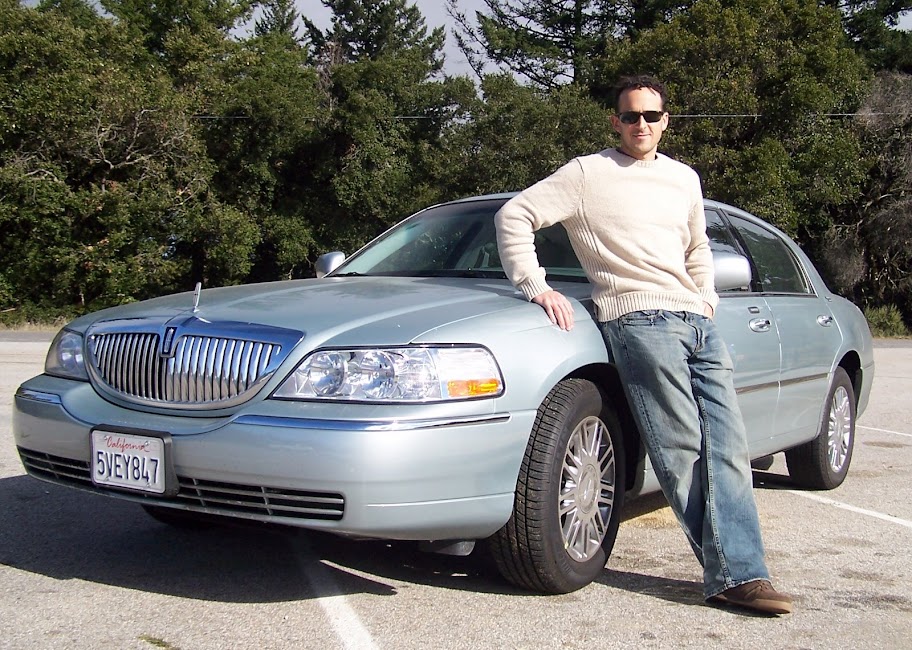
If you look in the gallery you can see our car. Due to it being the only one they had left, we were 'upgraded' by our car hire people from a little economical run-around (which we chose specially for it's ability to do 30mpg) to a complete behemoth of a Lincoln, which does 20mpg if we're very lucky. It's very comfy for travelling, but less pleasurable for the bank balance, and not to mention the environment.
Still, we've got two days of solid driving ahead of us, so maybe the added comfort isn't too bad...
PS You may also notice that, after 10 years, I have cut my hair! The dreads are still there, they're just really short. Feels different!
Thursday, December 28, 2006
USA Trip: Vegas and Joshua Tree
Well, of all the stories I had heard about the States before I came here, there's one that is 100% right. The cars here are huge; and I do mean huge. In fact, pretty much everything is huge, the landscape, the food, the roads, the people, everything. It's quite overwhelming, to be honest.
Djanira, her mum Uby, and I flew over here on Christmas Eve and we fly back to Britain on the 7th Jan. We flew into to Vegas, which is just as dros ben llestri as you'd imagine it to be, eveything is done completely over the top. We stayed in the Sahara hotel and casino, which is one of the cheaper places to stay, but still on the strip and quite good fun. We spent Christmas day wandering the strip in the sunshine, and had a massive buffet lunch at Flamingo - all the casino's have these amazing all-you-can-eat buffets, which are pretty good value. I'm not much of a gambler so I didn't play much, a few goes on the slots and computers, and one go on a blackjack table. I lost about 20 bucks on the machines but stayed even on the table. Good fun though.
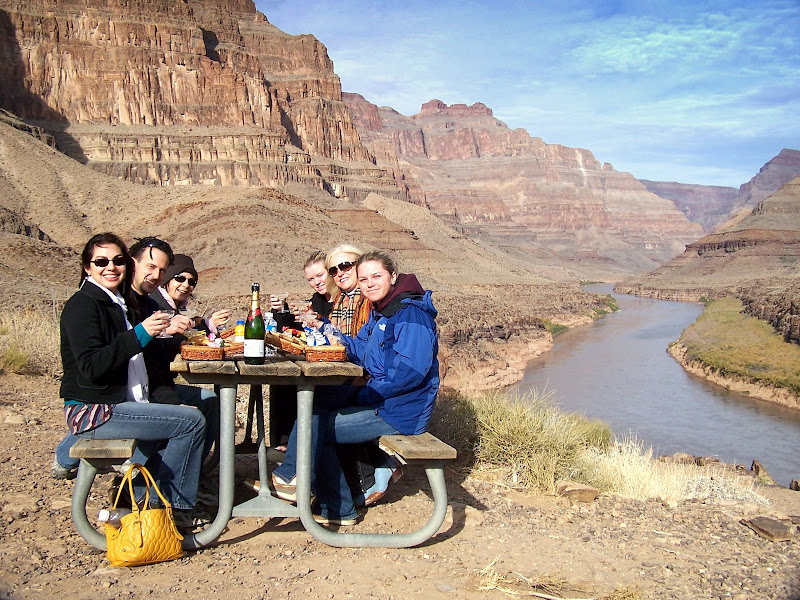
You may notice the photograph above is not in Vegas - in fact it's the Grand Canyon! As a christmas present to ourselves we flew by helicopter from Vegas to see the canyon, passing the Hoover dam on the way. It was all very impressive, and we landed on the canyon floor for a champagne brunch. Very nice indeed!
After returning to the city we picked up a hire car (which, naturally, is huge, and I do mean huge), and drove through the desert to Joshua Tree. J-Tree is a national park that represents the boundary between the Mojave and Colorado deserts, and is famous for the unique Joshua trees that grow there - U2 stayed there when writing their seminal album of the same name. It is also one of the most famous rock climbing areas in the whole world, so I was very excited to pull on my boots and do a bit of bouldering, when I get more time I'll dump the photos in my album.
After stopping there we drove an impressive road from Palm Springs over the San Jacinto
mountains, and are now in the house of DJ's uncle Francisco, in Vista, just to the north of San
Diego. Lovely weather today, and we're off to see 10ft swells breaking on the pacific shoreline - I don't think I'll go in the water today!
More to come soon...
Wednesday, December 20, 2006
Multilingualism
Being bilingual, and living with somebody who is trilingual, I am a big proponent of the importance of learning foreign languages at school. The issue has raised its head again in the news recently, with the government promising a drive to get kids to do more foreign languages - though it baffles me why they are suggesting this now, when only a few years ago they changed the curriculum so that it isn't mandatory to do a foreign language GCSE.
There is an interesting article in the paper about it today, written (in very elegant English) by a Frenchwomen, which got me thinking a little more on why I think learning a foreign language is so important.
The monolinguist's arguments are usually along the lines of "all the world speaks English, what's the point in learning another language?". In that respect, they have some sort of point, even it is a touch arrogant. Yet, to me, the main benefits of learning another language are not limited to the ability to converse in that language; rather, they are the enlightenment of realising that you aren't limited to a single method of expressing yourself linguistically*, and the appreciation of different cultures that can only be acquired by immersing yourself to the level where you have to use that culture's language.
At school I learned French to GCSE level, and went on two exchange visits to France, staying with French families. Being forced to speak French meant that I began to see the world a little bit through French eyes, and as a result I am a big fan of France, and the French people - not a view shared by many of my fellow Brits! But how many of them went on a French exchange? And if they didn't, would their prejudices against the French still exist if they had gone on an exchange?
The point I'm trying to make is that, even though I have forgotten much of my French now, I don't think for a second that learning the language was a waste of time. I learned far more than 'just another language'.
There is an interesting article in the paper about it today, written (in very elegant English) by a Frenchwomen, which got me thinking a little more on why I think learning a foreign language is so important.
"The global culture we live in is a double-faced creature, part angel, part devil. It induces two sets of behaviour in world citizens: a greater openness and a new curiosity towards others, or the illusory and self-satisfied conviction that the world has come to them. The first group, embracing multilingualism, have learned that a better understanding of other cultures, based on mutual knowledge of each other's languages, can foster stronger business partnerships, richer cultural exchanges and lasting peace. The second, often found in the English-speaking world, are proud of their monolingualism, and have retreated into a fantasy world in which it seems everyone speaks their language."
The monolinguist's arguments are usually along the lines of "all the world speaks English, what's the point in learning another language?". In that respect, they have some sort of point, even it is a touch arrogant. Yet, to me, the main benefits of learning another language are not limited to the ability to converse in that language; rather, they are the enlightenment of realising that you aren't limited to a single method of expressing yourself linguistically*, and the appreciation of different cultures that can only be acquired by immersing yourself to the level where you have to use that culture's language.
At school I learned French to GCSE level, and went on two exchange visits to France, staying with French families. Being forced to speak French meant that I began to see the world a little bit through French eyes, and as a result I am a big fan of France, and the French people - not a view shared by many of my fellow Brits! But how many of them went on a French exchange? And if they didn't, would their prejudices against the French still exist if they had gone on an exchange?
The point I'm trying to make is that, even though I have forgotten much of my French now, I don't think for a second that learning the language was a waste of time. I learned far more than 'just another language'.
* For some time I've pondered the best way of describing this (the idea that there isn't always an equivalent translation) to an English monolingual, and the best example I've come up with is translation of the word 'Welsh':
Cymraeg = Welsh (the language e.g. "she speaks Welsh")
Cymreig = Welsh (something that is from Wales e.g. "a Welsh harp")
Cymry = Welsh (the people of Wales e.g. "the Welsh sing very well")so;
the English can talk about English things in English;
but (to paraphrase)
the Cymry talk about Cymreig things in Cymraeg
Thursday, December 14, 2006
Changes afoot...
If you link to this page via my main webdomain, alunthomasevans.co.uk, you may have already noticed that there has been a bit of a change. If not, go there now to have a look at the first iteration of my 'professional' website. The idea is that I'll be applying for jobs again soon (I stop work here in the Ear Institute at the end of April), and so I wanted a more professional presence on the web...you know, a place to list my papers, download examples of my work, my CV etc. etc. and this is the first effort.
Being the bit of the geek that I am, I decided to make it a bit more impressive to fellow geeks (i.e. people that may be employing me in the future, and write it in a way that completely separates content from design. Hence I nipped off to learn about XSL, and the result is a page that always has the same design, despite the changing content, if you have a peek at the source code, you'll see it's all in XML, which is transformed by an XSL stylesheet to create the HTML, and I have used this to show-off my language madskillz, so that the same stylesheet transforms the content in three different languages. I'll probably write a bit more about it in Code Corner soon.
Some requests for help:
-My designing skills are atrocious, if anybody has any ideas how to make it look nice (without going over the top) then please do tell me.
- Siaradwyr Cymraeg: dwi heb ysgrifennu unrhywbeth ffurfiol ers talwm, felly dwi'n siwr bod 'na digonedd o gamgymeriadau yn fy iaith. Os oes gennych unrhyw cywiriadau neu syniadau, dwedwch plis!
- Los que hablan español: bueno, es obvio que todavía estoy aprendiendo español, por eso si tienes algunas correcciónes o sugerencias, por favor, dime!
if you don't know my email it is alun AT alunthomasevans.co.uk
Being the bit of the geek that I am, I decided to make it a bit more impressive to fellow geeks (i.e. people that may be employing me in the future, and write it in a way that completely separates content from design. Hence I nipped off to learn about XSL, and the result is a page that always has the same design, despite the changing content, if you have a peek at the source code, you'll see it's all in XML, which is transformed by an XSL stylesheet to create the HTML, and I have used this to show-off my language madskillz, so that the same stylesheet transforms the content in three different languages. I'll probably write a bit more about it in Code Corner soon.
Some requests for help:
-My designing skills are atrocious, if anybody has any ideas how to make it look nice (without going over the top) then please do tell me.
- Siaradwyr Cymraeg: dwi heb ysgrifennu unrhywbeth ffurfiol ers talwm, felly dwi'n siwr bod 'na digonedd o gamgymeriadau yn fy iaith. Os oes gennych unrhyw cywiriadau neu syniadau, dwedwch plis!
- Los que hablan español: bueno, es obvio que todavía estoy aprendiendo español, por eso si tienes algunas correcciónes o sugerencias, por favor, dime!
if you don't know my email it is alun AT alunthomasevans.co.uk
Sunday, December 10, 2006
Pinochet is dead
So, like Pol Pot, Idi Amin and several other criminals before him, General Augusto Pinochet cheats real justice and escapes to the land of the dead. He will not be missed by the majority, yet his death still comes as a blow to the thousands of Chileans, Spaniards, and people of all nationalities who wanted to see this man stand in the dock and face responsibility for his crimes.
Pinochet assumed power in Chile in a military coup d'etat in 1973. The incumbent president, Salvador Allende, had led a socialist government which had followed policies unpopular with the Chilean right, such as the nationalisation of industry and health service, and the seizure and redistribution of land and wealth. The coup was short, bloody and violent, with troops and tanks surrounding the Chilean palace in Santiago while it was bombed from the air. Allende died in the attack, and Pinochet emerged from the shadows to head the new military dictarship. The following months were a humanitarian disaster, with thousands of 'subversives' picked up by the secret police. At least 3000 people were killed, and several tens of thousands tortured - 40,000 alone were detained in Chile's national stadium, which had been converted to a concentration camp.
Despite these horrors and others, Pinochet remained a hero for many in Chile for some time after his removal from power, as some on the right still saw him as the saviour who prevented the country's slide into communism. However, this support had gradually eroded since it was discovered that he stole millions from the country's exchequer, skimming off funds and transferring them to a private swiss bank account. This was no upstanding citizen doing his best for his country; Augusto Pinochet was a common thief.
Baroness Margaret Thatcher is said to be 'deeply saddened' by his death. While I appreciate her point of view that his assistance during Falklands War may have saved British lives, it reflects rather badly on her judgment that she should continue to support a man who's name will forever be mentioned alongside some of the most infamous in history, and who be remembered by most as a repugnant man who had not a single redeeming quality.
Pinochet assumed power in Chile in a military coup d'etat in 1973. The incumbent president, Salvador Allende, had led a socialist government which had followed policies unpopular with the Chilean right, such as the nationalisation of industry and health service, and the seizure and redistribution of land and wealth. The coup was short, bloody and violent, with troops and tanks surrounding the Chilean palace in Santiago while it was bombed from the air. Allende died in the attack, and Pinochet emerged from the shadows to head the new military dictarship. The following months were a humanitarian disaster, with thousands of 'subversives' picked up by the secret police. At least 3000 people were killed, and several tens of thousands tortured - 40,000 alone were detained in Chile's national stadium, which had been converted to a concentration camp.
Despite these horrors and others, Pinochet remained a hero for many in Chile for some time after his removal from power, as some on the right still saw him as the saviour who prevented the country's slide into communism. However, this support had gradually eroded since it was discovered that he stole millions from the country's exchequer, skimming off funds and transferring them to a private swiss bank account. This was no upstanding citizen doing his best for his country; Augusto Pinochet was a common thief.
Baroness Margaret Thatcher is said to be 'deeply saddened' by his death. While I appreciate her point of view that his assistance during Falklands War may have saved British lives, it reflects rather badly on her judgment that she should continue to support a man who's name will forever be mentioned alongside some of the most infamous in history, and who be remembered by most as a repugnant man who had not a single redeeming quality.
Wednesday, December 06, 2006
Game reviews: Oblivion and God of War
 What with all current the hoo-haa regarding various new console releases, recently I had the urge to dust off my gaming madskillz and play a couple of titles that I have meaning to look at for a while. Mr Paul kindly gave me a copy of God of War about a year ago, but to be honest I dismissed it completely at the time, because it looked a little bit of a teenagers game. You see, I'm an adult, I like mature games with decent storylines and non-linear interaction and if they must be violent, then at least make it tasteful violence. :P Hence the reason that for the last few months I have been playing a rather different sort of game to God of War, called Elder Scrolls IV: Oblivion.
Oblivion is a role-playing game in which you play some punter who is rather randomly drawn into a whirlwind quest to save the world from ultimate doom. Okay - so the story's a bit of a hack, but the game is pretty much about as non-linear as you can get, without making it so random that the player doesn't know where they are or what to do. The game world is completely huuuge, and while it is possible to 'fast travel' by clicking on a map, you can quite feasibly walk the whole way should you choose to do so. And you might as well - this is first game I have played where, when descending a mountain trail at sunset, I have actually stopped to admire the view. It really is rather impressive.
The vastness of the world, and the non-linear method you can use to explore it, is both the game's strength and weakness. There's no doubt that having such a large and engrossing world is wonderful; there's one large city and several small towns dotted about the map, and loads of stuff to do and explore in each one. You can spend hours, days even, just poking around and sticking your nose in to the thousands of side-quests that exist. And the 'main' quest, where the central story of the game unfolds, is always there in the background for you to do as much or as little as you like - until you complete it of course.
Yet therein lies the problem. Classic epics like Final Fantasy VII worked well due the world developing alongside the main story, Oblivion's world feels static by comparison. It doesn't help that they used the same five actors to voice every character in the game, and the 'random' conversations between NPCs (non-player-characters) become laughably repetative. At the end of the day, Oblivion's failings in this regards highlight an interesting point - while non-linear gaming gives a greater sense of freedom, unless the gaming world develops over time, that same non-linearity hamstrings the game as much as fully-linear-walk-this-direction-only experience.
Which, neatly enough, returns us to God of War. After getting it, the game gathered dust in it's box for a while until my old flat mate, Chris Jennions, picked it up one bored evening, about a year ago. While half-watching him play the first few levels, my initial suspicions seemed to be confirmed - it appeared to be nothing more than button-mashing, disengage-brain, 3D scrolling beat-em-up. Yet, after a few weeks, I noticed that Chris was still playing it, and thoroughly enjoying it. When I discovered, some time later, that itwon a few 'Game-of-the-Year' awards and that even the very strict Edge magazine awarded it 8/10, I decided that one day I would get round to playing it. A fortnight ago, that day arrived. And don't you know it, it's rather good.
It is still, of course, a button-mashing, disengage-brain, 3D scrolling beat-em-up. What separates it from the dross that is 99% of the rest of the games in this genre is the fact that it obviously has very high production values. The camera, traditionally a sticking point in such games, is almost always in exactly the right spot, following you relentlessly through corridors and across deserts, and panning, zooming and rotating to show your environment when necessary. The graphics are great considering it's only the PS2, and everything from the greek-mythology story, to the control system that expands throughout the game, to the suitably grandiose soundtrack, is well conceived. It is undoubtedly an entirely on-rails linear experience, with little chance to deviate from the path in front of you, and as such it couldn't be more different to Oblivion. But if I was forced to play one of the two games again, I would probably choose God of War - maybe I'm still a teenager at heart!
Tuesday, November 28, 2006
Capoeira Canal Christmas Roda
My capoeira teacher, Monitor Risadinha (Jacob is his real name, Risadinha is his Capoeira apelido - once you get to certain standard you get 'baptized' and given a nickname. Monitor is his 'grade') is on a plane to Brazil as I write, for a three week holiday and to train with an academy out there, and last night we had our final lesson of the year with him. So we decided to make it a bit of an occasion, especially as it coincides with the two year anniversary of the school, Capoeira Canal, which is a good achievement for Jacob.
The class followed a slightly different format to normal. Usually, we warm up together, then the beginners and intermediates split for the majority of the class, and we get back together at the end for a little roda. The roda (Portuguese for 'wheel') is the circle of people and instruments, within which two people play Capoeira. It is the whole point of Capoeira, really. Anyway usually we just have a little roda at the end of the class, lasting 20-30 minutes, everybody has one quick game, and that's it. Yesterday, however, as it was a special occasion, we had decided in advance to start the roda early and have a 'proper' one. So after a quick warm up we got the instruments out and started playing.
It was great. My capoeira has improved loads and now I feel confident enough to not embarrass myself, and I really enjoy playing the instruments and singing also. Towards the end of a roda the music speeds up, the capoeira speeds up, and the whole thing becomes really engrossing - especially when you're watching two really good capoeiristas play a game, it's spellbinding. It's also amazing how fast the time goes, I had barely had two games before I glanced up at the clock and realised an hour had gone and I was unlikely to get another, as time was running out. Ah well. Still a brilliant evening, which we discussed and washed down with a couple of pints afterwards. Very nice indeed.
So now I'm really enthused for Capoeira and, fortunately, classes are continuing, despite Jacob being away. For the next couple of weeks we have some intructors from our 'parent' school (i.e. Jacob's old school) the London School of Capoeira coming to take the next two Monday classes, so it will be interesting to see how their teaching methods differ to Jacob's. Cool beans.

The class followed a slightly different format to normal. Usually, we warm up together, then the beginners and intermediates split for the majority of the class, and we get back together at the end for a little roda. The roda (Portuguese for 'wheel') is the circle of people and instruments, within which two people play Capoeira. It is the whole point of Capoeira, really. Anyway usually we just have a little roda at the end of the class, lasting 20-30 minutes, everybody has one quick game, and that's it. Yesterday, however, as it was a special occasion, we had decided in advance to start the roda early and have a 'proper' one. So after a quick warm up we got the instruments out and started playing.
It was great. My capoeira has improved loads and now I feel confident enough to not embarrass myself, and I really enjoy playing the instruments and singing also. Towards the end of a roda the music speeds up, the capoeira speeds up, and the whole thing becomes really engrossing - especially when you're watching two really good capoeiristas play a game, it's spellbinding. It's also amazing how fast the time goes, I had barely had two games before I glanced up at the clock and realised an hour had gone and I was unlikely to get another, as time was running out. Ah well. Still a brilliant evening, which we discussed and washed down with a couple of pints afterwards. Very nice indeed.
So now I'm really enthused for Capoeira and, fortunately, classes are continuing, despite Jacob being away. For the next couple of weeks we have some intructors from our 'parent' school (i.e. Jacob's old school) the London School of Capoeira coming to take the next two Monday classes, so it will be interesting to see how their teaching methods differ to Jacob's. Cool beans.
Subscribe to:
Posts (Atom)